The Billion-Dollar Wallets That Disappeared: A Tour of Crypto's Most Expensive Lost Coins
James Howells threw the wrong hard drive in a landfill. Stefan Thomas has two password attempts left on $250M of Bitcoin. Matthew Mellon died on $1B of XRP nobody could find. A look at the most expensive mistakes in cryptocurrency, and the simple precautions that would have prevented every one.
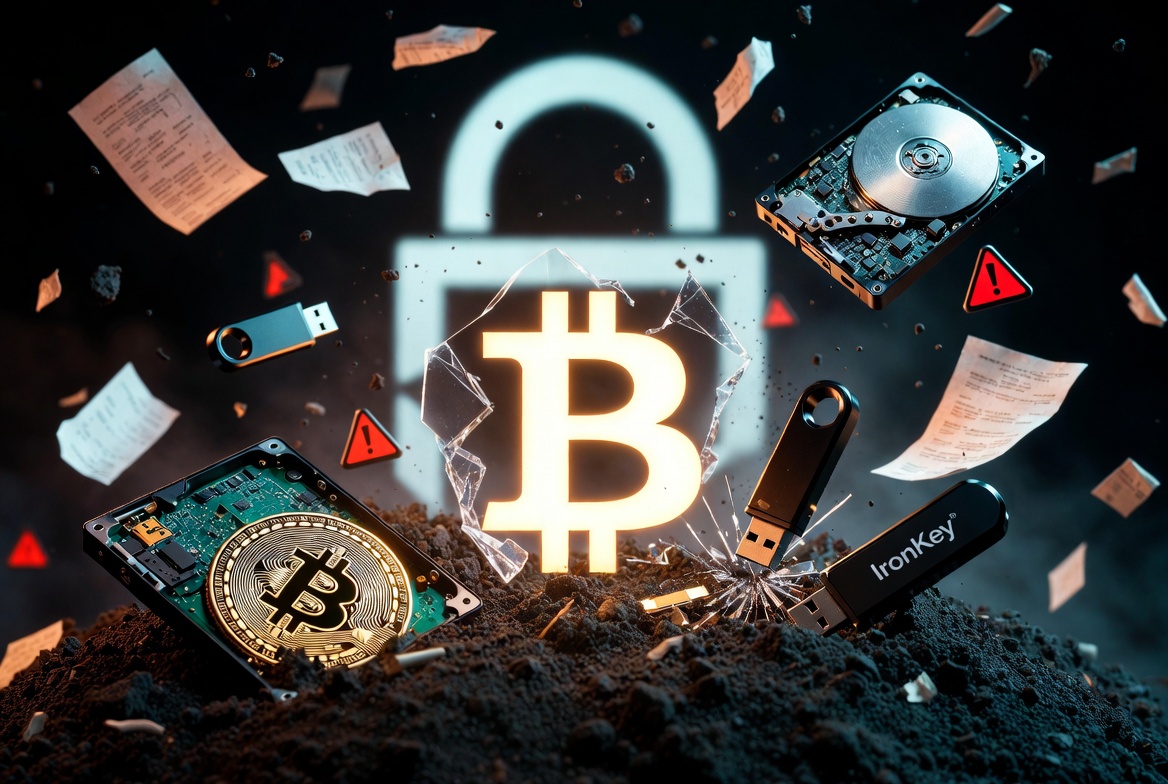
A Tour of the Most Expensive Mistakes in Cryptography
The thing nobody told the early Bitcoin holders was that the security model they were so proud of, "be your own bank, no third party can take your money", has a less inspiring corollary. The exact same architecture that means no one can take your coins also means no one can give them back if you forget how to find them.
Probably 3 to 4 million Bitcoin are permanently lost. At current prices, that's hundreds of billions of dollars in mathematically valid wealth that no one, not the holder, not the holder's heirs, not Satoshi Nakamoto, not the SEC, can move, ever again. This is by design. The protocol does not care that you forgot.
Most of these losses are quiet. Someone sets up a wallet in 2011, mines a few coins, loses interest, moves on, deletes the laptop a few years later. Nobody writes a story about it because nobody knows it happened.
But some losses are spectacular. The kind that make the front page of news outlets. The kind that, examined closely, illustrate exactly which categories of mistake are easiest to make, and which simple precautions would have prevented them.
This is a tour of the loudest losses in the history of cryptocurrency, with a brutally short note after each one about what would have changed the outcome.
James Howells: The Newport Landfill
In 2009, a Welsh IT worker named James Howells mined 8,000 Bitcoin on a hard drive in his bedroom. In 2013, while cleaning out his office, he threw the wrong hard drive in the trash. It was eventually buried in a landfill in Newport, Wales.
Estimated value at peak: over $700 million.
Howells has spent more than a decade campaigning to be allowed to excavate the landfill. He has hired a team. He has secured funding. He has commissioned environmental studies. As of this writing, the city has not granted permission, citing the environmental impact of digging up a landfill containing other people's medical waste, asbestos, and household refuse.
The hard drive, presumably, is still there. The Bitcoin, mathematically, is still there. The keys are inside the drive, encoded in the disk's magnetic state, untouchable behind both physical and bureaucratic barriers.
What would have changed the outcome: A single backup of the wallet seed phrase, on paper, anywhere else.
Stefan Thomas: Two Attempts Left
Stefan Thomas, an early Bitcoin advocate and the founder of Coil, owns 7,002 BTC. He stores them on an IronKey, a hardware-encrypted USB drive designed to permanently brick itself after ten incorrect password attempts.
He has used eight of those attempts.
He wrote down the password. He lost the paper.
If he tries the wrong password two more times, the IronKey will encrypt itself with a randomly generated key it then deletes, rendering the contents permanently inaccessible. He has, by his own description, accepted that the coins might be lost. He has taken meditation classes to deal with the psychological weight of carrying around hundreds of millions of dollars he cannot spend.
Various crackers have approached him over the years offering to attempt to break the IronKey. Most discussions have gone nowhere; the device's hardware security has held up. As of this writing, the wallet has not been opened.
What would have changed the outcome: Multiple backups. A standard practice today: write down the seed phrase in two places, store them separately, use one as the working copy and the other as deep cold storage. Don't trust a single piece of consumer hardware with your only key material.
Matthew Mellon: The Banking Heir's XRP
Matthew Mellon, an heir to two prominent American banking families, became one of the largest individual holders of XRP. By 2018 his holdings were estimated at over $1 billion.
He died in April 2018 of a heart attack at age 54.
His estate spent years trying to recover the XRP. Mellon had reportedly stored the keys across multiple wallets and devices, with passwords held by various advisors and family members in fragmented form. He had not consolidated the recovery information into anything coherent. His estate was forced to sell off significant portions at unfavorable prices, and reports suggest a substantial fraction was simply unrecoverable.
The legal proceedings around the estate dragged on for years. Estimates of the unrecoverable portion vary by source but are generally measured in hundreds of millions of dollars.
What would have changed the outcome: A single document that consolidated which wallets existed, where the keys were, and how the family or executor could access them. Mellon was sophisticated enough to spread his holdings across multiple wallets. He was not sophisticated enough to write down which wallets existed.
Gerald Cotten and QuadrigaCX
Gerald Cotten was the CEO of QuadrigaCX, at one point Canada's largest cryptocurrency exchange. He died in December 2018 in India, at age 30, of complications from Crohn's disease.
He was reportedly the only person who held the keys to the exchange's cold wallets, where roughly $190 million CAD of customer funds were stored.
The story collapsed under scrutiny. Investigators eventually concluded that the cold wallets were largely empty, that customer funds had been used by Cotten for personal trading and lifestyle expenses, and that what looked like a tragic key-management disaster was in significant part a Ponzi-like scheme that the death merely revealed.
But the original premise, that an exchange could be bricked overnight by the death of one person who held all the keys, was real, and the story remains a case study in why no institution should ever rely on a single human as the sole custodian of any meaningful sum.
What would have changed the outcome: Multisignature cold storage. Threshold key management. Independent audits. Anything other than "one guy, one laptop, one passphrase he never wrote down for anyone." Even setting aside the alleged fraud, the technical setup violated every principle of institutional security.
Mt. Gox: The Slow-Motion Collapse
In 2014, Mt. Gox, at the time handling roughly 70% of all Bitcoin transactions globally, suspended trading and filed for bankruptcy. Approximately 850,000 BTC belonging to customers were unaccounted for.
This wasn't a single inheritance disaster but a sustained mismanagement of customer funds, key material, and basic operational security. Among other failures, the exchange had stored most of its hot wallet funds in a single bitcoin wallet that had been continuously drained by attackers over a period of years before anyone noticed.
The bankruptcy proceedings continue to this day, more than a decade later. Recovered funds are slowly being distributed. Many customers will receive a fraction of what they were owed.
What's relevant for our purposes: many of the affected customers had stored their Bitcoin on Mt. Gox specifically because self-custody felt scary and complicated. They wanted someone else to handle the keys. The someone else turned out to be worse at it than they would have been.
What would have changed the outcome: Self-custody, with redundant key backups and a documented inheritance plan. The cost of doing it yourself is real. The cost of trusting an institution that turns out to be incompetent or fraudulent is much higher.
The Long Tail
The named cases above are the famous ones. The unfamous cases vastly outnumber them.
- The early Bitcoin miners who threw away laptops in 2012, before they understood what they had.
- The wives and husbands of crypto enthusiasts who died unexpectedly without sharing seed phrases.
- The teenage holders of millions in gaming-cryptocurrency assets whose parents have no idea the assets exist.
- The aging parents who set up a small Coinbase account during the 2017 boom and forgot about it, whose adult children won't find it during the estate inventory.
- The early Ethereum participants whose wallet files are sitting in a backup folder on a computer nobody remembers the login for.
Chainalysis and other on-chain analytics firms can identify lost coins by looking for wallets that have been completely dormant for many years. The conservative estimates of permanent Bitcoin loss start in the millions of coins. The total dollar value of cryptocurrency that has been mathematically forfeited to forgetfulness, accident, and death is in the hundreds of billions.
What These Stories Have in Common?
A few patterns repeat across nearly every public case of significant crypto loss:
- A single point of failure. One device, one password, one paper, one brain. No redundancy.
- Procrastination on documentation. "I'll write it down later" is the most expensive sentence in cryptocurrency.
- Optimism about consumer hardware. Hard drives die. USB sticks corrupt. Phones get dropped in pools. Hardware wallets break. None of these are reliable as primary storage; all of them are useful as one of several redundant copies.
- Misjudging the inheritance problem. Most holders treat the question as "what happens to my crypto if I die?" The more honest version is "what happens to my crypto if I forget my password, lose my hardware, become incapacitated, or simply don't show up tomorrow for any reason?" The death case is one specific instance of a more general failure mode.
- A reluctance to share, born of distrust. "I don't want anyone else to have access" is rational while you're alive. It becomes irrational the moment you stop being alive, at which point the crypto is no more useful than a tree fell in a forest with no one around. The right answer is conditional sharing: keys delivered to specific people only when specific conditions are met.
What "Conditional Sharing" Actually Means?
Crypto inheritance, done correctly, looks like this:
- Your seed phrases and wallet documentation live in an encrypted vault.
- The vault delivers to designated beneficiaries only when you stop checking in for a configurable period.
- The trigger conditions are explicit, monitored, and tamper-evident.
- The recipients don't need to be technically sophisticated; the vault includes step-by-step instructions for what to do with what.
- The whole thing keeps working even if the platforms underneath it (your password manager, your exchange, your hardware wallet vendor) change or fail, because the master copy is encrypted text you control.
This is not a complicated concept. It's not even a particularly clever one. It is, however, the thing that none of the famous victims above had set up.
The cost of setting it up is roughly an hour. The cost of not setting it up is illustrated above, in nine-figure increments.
If you hold meaningful cryptocurrency and you have not done this, you are not James Howells, Stefan Thomas, or Matthew Mellon, yet. The path that gets you there is short and well-trodden, and it starts with "I'll set up something better next week."
Don't be next week's headline.
Related Reading
- Background: what a dead man's switch is and how it works
- How to avoid being on this list: how to pass crypto to your family when you die
- The newer asset classes with the same problem: NFTs, Web3, and on-chain inheritance
Killswitch stores your seed phrases, wallet documentation, and recovery instructions encrypted at rest and in transit. When you stop checking in, the right people receive the right keys, automatically, with full instructions, with tamper-evident logs. Conditional sharing, done correctly, finally available to individuals. Get started today
FAQ
What should I know about A Tour of the Most Expensive Mistakes in Cryptography?
The thing nobody told the early Bitcoin holders was that the security model they were so proud of, "be your own bank, no third party can take your money", has a less inspiring corollary. The exact same architecture that means no one can take your coins also means no one can give them back if you forget how to find them..
What should I know about James Howells: The Newport Landfill?
In 2009, a Welsh IT worker named James Howells mined 8,000 Bitcoin on a hard drive in his bedroom. In 2013, while cleaning out his office, he threw the wrong hard drive in the trash.
What should I know about Stefan Thomas: Two Attempts Left?
Stefan Thomas, an early Bitcoin advocate and the founder of Coil, owns 7,002 BTC. He stores them on an IronKey, a hardware-encrypted USB drive designed to permanently brick itself after ten incorrect password attempts.
What should I know about Matthew Mellon: The Banking Heir's XRP?
Matthew Mellon, an heir to two prominent American banking families, became one of the largest individual holders of XRP. By 2018 his holdings were estimated at over $1 billion.
What should I know about Gerald Cotten and QuadrigaCX?
Gerald Cotten was the CEO of QuadrigaCX, at one point Canada's largest cryptocurrency exchange. He died in December 2018 in India, at age 30, of complications from Crohn's disease.
What should I know about Mt. Gox: The Slow-Motion Collapse?
In 2014, Mt. Gox, at the time handling roughly 70% of all Bitcoin transactions globally, suspended trading and filed for bankruptcy.