How to Write a Legacy Journal Your Family Will Actually Receive
A legacy journal is written for someone, not just about yourself. Here's how to start one, keep it going, and make sure your family actually receives it.
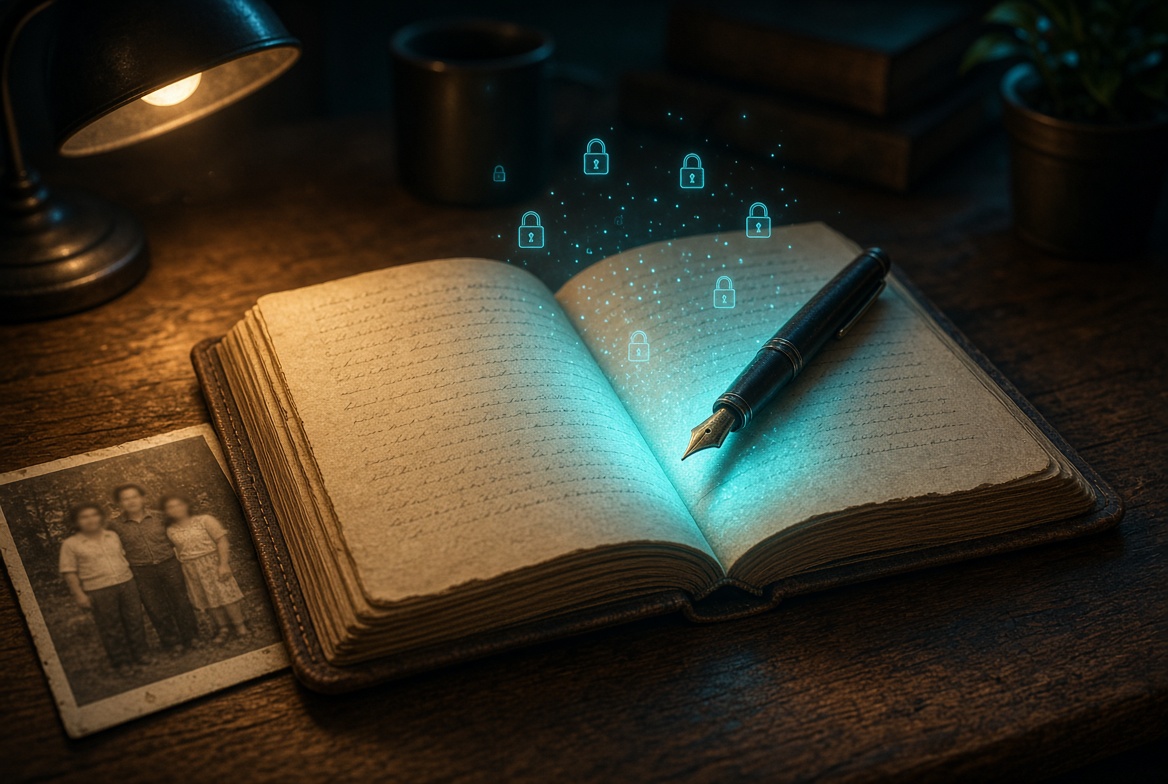 There's a drawer in almost every family's house that holds the things nobody knows what to do with. Old letters. A watch. Photographs of people whose names have been forgotten. And sometimes, if the family is lucky, a journal.
If you've ever read even a page of a grandparent's handwriting, a grocery list, let alone a real entry, you know the weight those pages carry. Not because the writing was beautiful. Because it was them. Their worries about money, their small joys, the way they described a snowstorm in 1964. A few paragraphs can do what no photo can: let you hear someone's voice again.
That's what a legacy journal is for. And it's different from a diary in one important way.
A legacy journal is written for someone
A diary faces inward. You write to process the day, vent, figure out what you think. It's for you, and that's a good and healthy thing.
A legacy journal faces outward, and forward. It's written for a reader who isn't in the room yet. Your kids. Your spouse. Grandchildren you may never meet. It's less "Dear Diary" and more "Dear you, reading this someday."
That shift changes everything about how you write. A diary entry about a hard week might be a tangle of frustration. A legacy journal entry about the same week says: here's what this was like, and here's what I want you to know about getting through things like it. You're not just recording your life. You're handing it to someone.
Some people call this a memory journal or a family memory journal. The name matters less than the orientation: it's a journal with a recipient.
How to start when the blank page is terrifying?
The biggest reason legacy journals never get written is that people aim too high. They sit down to write for posterity, for some vast imagined audience of descendants, and freeze. Posterity is intimidating. Nobody can write to posterity.
So don't. Write to one person.
Pick your daughter, your husband, the grandson who was born last spring. Put their name at the top of the entry: "Dear Emma." Suddenly you're not composing a historical document; you're writing a letter to someone you love, which you already know how to do. The tone finds itself. The stories pick themselves.
If you still need a nudge, here are fifteen prompts, organized by who you're writing to.
To your kids:
- The day you were born, what I remember, what I felt, what the weather was doing.
- What I believed at your age, and what I believe now.
- The mistake that taught me the most.
- The story of how I met your mother / your father.
- What I was afraid of when I became your parent, and what turned out to be true.
To your spouse:
- The moment I knew.
- The hardest year we had, from my side of it.
- The ordinary day I'd relive if I could.
- What I hope you do, really, if I go first.
To grandchildren you may never meet:
- Where our family comes from, as far back as I know it.
- What the world looked like when I was young, and what I hope it looks like for you.
- The family recipe, the family joke, the family flaw.
The practical entries (less romantic, deeply appreciated):
- Why our estate plan is set up the way it is, so nobody has to guess at my reasoning, or argue about it.
- The story behind the things: the house, the ring, the tools in the garage, and who I hope ends up with them.
- Who to call, and what I never got around to telling you about how our household actually runs.
That last group matters more than people expect. Grief is disorienting enough without mystery. An entry that plainly says here's why I did it this way can prevent years of hurt feelings between siblings. It's one of the kindest, least glamorous gifts you can leave.
One entry a week beats a memoir you never finish
The second reason legacy journals fail: people treat them as a project instead of a practice. They imagine a finished memoir, chapters, an arc, a beginning and end, and since there's never a free month to write it, they never start.
A legacy journal isn't a book. It's an accumulation. Twenty minutes a week, kept up for a few years, becomes hundreds of entries, a portrait far truer than any memoir, because it was written in real time, in your real voice, before you knew how the story turned out.
The trick is to tie it to a ritual you already have. Sunday evening, when the house goes quiet, is the classic slot. Birthdays and anniversaries are natural triggers, write to the birthday person, about them. Some families use conference weekend, or the drive home from a holiday, or the first day of every month. The specific ritual doesn't matter. What matters is that the journal borrows the ritual's momentum instead of needing its own.
And lower the bar for what counts. An entry can be four sentences. It can be a voice memo describing the dinner you just cleaned up after. "Short and done" beats "profound and imaginary" every single time.
The part every journal app ignores: delivery
Here is the uncomfortable truth about legacy journals, and the reason we built what we built.
A paper journal can be lost. It can burn with the house, get water-damaged in a basement, or simply never be found, tucked in a box the estate-sale company hauls away. Families discover a parent's journal decades late, or never.
A journal app has the opposite problem. Everything is preserved perfectly, behind your password. When you're gone, your journal sits in an account nobody can open, on a phone nobody can unlock, until the subscription lapses and it's deleted. All that love, written down faithfully for years, and it never arrives.
That's the thing to understand: what makes a legacy journal real isn't the writing. It's the arriving. A journal your family never receives is, for their purposes, a journal you never wrote.
So whatever tool you use, paper, a document, an app, ask one question of it: how does this reach my family without me? If the honest answer is "it probably won't," fix that first, before you write another word. Tell someone where the notebook lives. Put instructions in your estate documents. Something.
How Killswitch handles it?
We built Killswitch's journal around that one question. The site's promise says it plainly: don't just keep a journal. Leave one.
In Killswitch, a journal isn't a side feature, it's a first-class deliverable item, the same as a letter or a document:
- A calendar view of your entries, so your weekly ritual has a home and you can see the record building over time.
- Video and audio entries recorded right from your phone, because for the people you leave behind, your voice and your face are the entries that matter most. (More on that in adding video and audio messages to notebook entries.)
- PDF export, whenever you want a printed copy for the drawer after all.
- Encrypted at rest and in transit with AES-256, so it's protected while it waits.
- Attached to a deadman switch or a scheduled date. You choose exactly who receives it and when, after your check-ins stop, or on a date you set, like a child's eighteenth birthday. Delivery doesn't depend on anyone finding anything.
- Beneficiaries don't need an account. Your kids won't need to sign up for anything or know a password. The journal simply arrives.
If you want to see how this works in the hardest case, the journal that only exists because you might not be there to explain things yourself, we wrote about that separately in the "if I'm gone" journal.
Start with one entry
Not fifteen. One. Pick one person, pick one prompt, the day you were born is a good first one, and write four honest sentences tonight. Next Sunday, write four more.
Someday, someone you love is going to sit down with what you wrote and hear your voice again. That only happens if you start, and it only matters if it arrives. Take care of both.
Ready to leave a journal, not just keep one? Get started today.
FAQ
What should I know about A legacy journal is written for someone?
A diary faces inward. You write to process the day, vent, figure out what you think.
How to start when the blank page is terrifying?
The biggest reason legacy journals never get written is that people aim too high. They sit down to write for posterity, for some vast imagined audience of descendants, and freeze.
What should I know about One entry a week beats a memoir you never finish?
The second reason legacy journals fail: people treat them as a project instead of a practice. They imagine a finished memoir, chapters, an arc, a beginning and end, and since there's never a free month to write it, they never start.
What is the part every journal app ignores: delivery?
Here is the uncomfortable truth about legacy journals, and the reason we built what we built.
How Killswitch handles it?
We built Killswitch's journal around that one question. The site's promise says it plainly: don't just keep a journal.