Cryptocurrency Inheritance: How to Pass Crypto to Your Family When You Die
Billions in crypto is lost forever because holders die without sharing their keys. This guide covers five methods for passing Bitcoin and other crypto to your family—from direct key sharing to encrypted deadman switches.
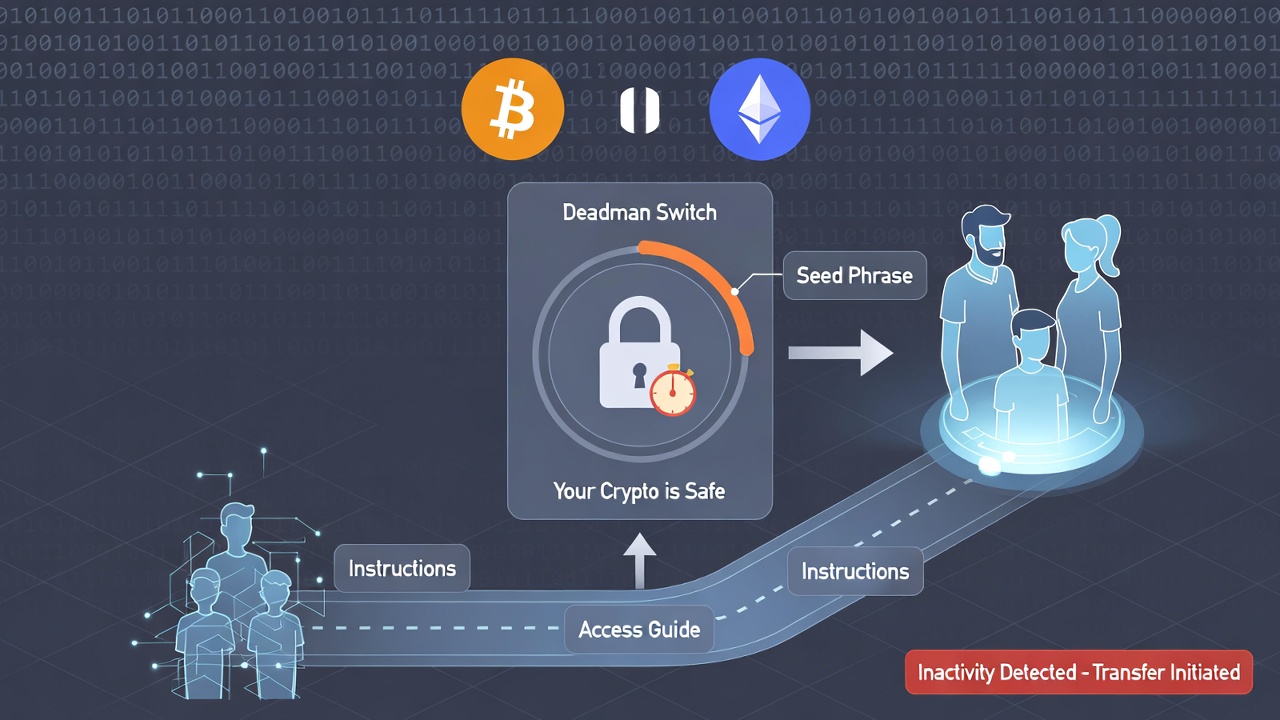 Every year, billions of dollars in cryptocurrency become permanently inaccessible because the holder died without sharing their private keys. Unlike bank accounts, there's no customer service to call, no death certificate process, no legal mechanism to recover funds. If your seed phrase dies with you, your crypto dies with you.
This is the brutal reality of self-custody: the same features that make crypto uncensorable and seizure-resistant also make it uninheritable by default. Your spouse, kids, or family can't access what they don't have the keys to—no matter what your will says.
The solution is planning ahead. This guide covers how to ensure your crypto reaches your family if something happens to you, without exposing your keys while you're alive.
The Crypto Inheritance Problem
Traditional assets have built-in inheritance mechanisms. Banks freeze accounts upon death notification, then release funds to verified beneficiaries. Brokerages transfer stocks through established legal processes. Real estate passes through probate with clear title transfer.
Crypto has none of this.
Your private keys are the only proof of ownership. There's no account recovery, no central authority to appeal to, no legal process that can force a blockchain to release funds. If your family doesn't have your keys, they have nothing—regardless of what legal documents exist.
The numbers are staggering. Estimates suggest 3-4 million Bitcoin are permanently lost, many belonging to holders who died without passing on access. At current prices, that's over $100 billion in inaccessible wealth. And that's just Bitcoin.
Why Most Crypto Holders Don't Plan
"I'll deal with it later." Crypto holders skew young. Death feels abstract. But accidents, sudden illness, and unexpected events don't check your age first.
"My spouse wouldn't know what to do anyway." This is solvable. You can leave instructions alongside keys. The hard part is getting them the keys—not teaching them to use Coinbase.
"I don't want anyone knowing how much I have." Valid concern. But there are ways to pass on access without revealing holdings while you're alive.
"Hardware wallets are secure enough." Your Ledger is useless to your family without the PIN and seed phrase. Physical security doesn't equal inheritance planning.
"I'll just tell my spouse the password to my password manager." And if you both die in the same accident? Or if you become incapacitated and can't communicate? Single points of failure kill inheritance plans.
Methods for Passing Crypto to Family
Option 1: Share Keys Directly
The simplest approach—give your spouse or family member your seed phrases and wallet passwords now.
Pros:
- Immediate access if something happens
- No technical complexity
- No ongoing costs
Cons:
- They can access funds anytime (trust required)
- Seed phrases sitting in a safe are a security risk
- Doesn't work if you want to keep holdings private
- No protection if they die too
This works for high-trust relationships with modest holdings. For larger amounts or complex family situations, it's too risky.
Option 2: Lawyer or Safety Deposit Box
Store seed phrases with an attorney or in a bank safety deposit box, with instructions for release upon death.
Pros:
- Professional custody
- Established legal frameworks
- Seed phrases not in your home
Cons:
- Lawyers can be hacked, subpoenaed, or make mistakes
- Safety deposit boxes require probate to access (months of delay)
- Neither understands crypto—mistakes happen
- Annual costs add up
- You're trusting a third party with keys
The irony of using banks to secure crypto isn't lost on anyone. And probate delays defeat the purpose of having liquid assets.
Option 3: Multisig Wallets
Split key control across multiple parties. For example, a 2-of-3 multisig where your spouse, your brother, and your lawyer each hold one key. Any two can move funds.
Pros:
- No single point of failure
- No single party can steal funds
- Cryptographically enforced rules
Cons:
- Complex setup
- All keyholders need to stay accessible and competent
- Coordination required for any transaction
- If two keyholders collude or become unavailable, funds are stuck
- Technical knowledge required across multiple people
Multisig is powerful but operationally complex. It works best for organizations or technically sophisticated families.
Option 4: Shamir's Secret Sharing
Split your seed phrase into multiple shares where a threshold (like 3-of-5) is needed to reconstruct it. Distribute shares to trusted people or locations.
Pros:
- No single person has full access
- Redundancy against lost shares
- Mathematically secure
Cons:
- Reconstruction requires coordination
- Recipients need to understand the process
- One corrupted share can prevent recovery
- Still requires trusting multiple parties
Similar tradeoffs to multisig, but works with standard wallets. Tools like SLIP39 implement this, but it's not beginner-friendly.
Option 5: Deadman Switch Services
Store encrypted seed phrases and instructions in a service that automatically releases them to designated beneficiaries if you stop checking in.
Pros:
- Automatic release—no probate, no lawyers, no delays
- Keys stay private until needed
- Everything is encrypted at rest (how the encryption works) — and for maximum protection you can encrypt the file yourself before uploading
- Works even if you're incapacitated (not just dead)
- Simple for beneficiaries—they receive a link
Cons:
- Ongoing subscription cost
- Must remember to check in
- Trusting service will exist long-term
- Accidental triggers possible (mitigated by grace periods)
For most people with significant crypto holdings, a deadman switch offers the best balance of security, simplicity, and automation.
What Your Family Actually Needs
Don't just pass keys—pass context. Your spouse finding a 24-word seed phrase with no instructions is almost as bad as finding nothing.
Include with your crypto inheritance:
- What you own: List of assets, approximate values, which wallets hold what
- Where the keys are: Seed phrases, PINs, passwords for each wallet
- How to access it: Step-by-step instructions assuming zero crypto knowledge
- Who to contact: A trusted friend or advisor who understands crypto and can help
- What to do with it: Sell immediately? Hold? Transfer to specific accounts?
- Tax implications: Warn them about capital gains and connect them with a crypto-aware accountant
A secure note alongside your seed phrases can contain all of this. Make it idiot-proof—assume they're reading it during the worst moment of their life.
Sample Inheritance Instructions
Here's a template for what to include:
CRYPTO INHERITANCE INSTRUCTIONS
[Your name] - Last updated [date]
Overview I own cryptocurrency worth approximately $[X] as of [date]. This document explains how to access it.
DO NOT share this information with anyone except [spouse name] or [backup person].
Assets
| Asset | Approximate Value | Wallet |
|---|---|---|
| Bitcoin | $XX,XXX | Ledger Nano X |
| Ethereum | $X,XXX | Ledger Nano X |
| [Other] | $X,XXX | [Location] |
Hardware Wallet Access
My Ledger Nano X is in [location]. The PIN is [XXXX].
To access funds:
- Download Ledger Live from ledger.com (official site only)
- Connect the device via USB
- Enter PIN when prompted
- Your balances will appear in Ledger Live
Seed Phrase (CRITICAL - NEVER SHARE)
The 24-word recovery phrase for my Ledger is: [word1] [word2] [word3]... [word24]
If the hardware wallet is lost or broken, this phrase can recover all funds. Use it with a new Ledger or compatible wallet.
Recommended Next Steps
- Don't panic. The crypto isn't going anywhere.
- Contact [trusted friend name] at [phone] - they understand crypto and can help.
- Consider moving funds to [Coinbase/Kraken/exchange] for easier management.
- Consult [accountant name] about tax implications before selling.
Exchange Accounts
I also have accounts at:
- Coinbase: [email], password in [password manager]
These are custodial—you can recover access through their standard process with death certificate.
Setting Up Crypto Inheritance Today
Minimum viable plan (30 minutes):
- Write down all your seed phrases and wallet PINs
- Add instructions your spouse could actually follow
- Store in a fireproof safe
- Tell your spouse where the safe is and the combination
This isn't perfect, but it's infinitely better than nothing.
Better plan (1-2 hours):
- Create the documentation above
- Store it in a deadman switch that encrypts everything at rest
- Set your spouse as beneficiary
- Configure weekly or monthly check-ins
- Test that they receive access correctly
Comprehensive plan:
- Deadman switch for immediate access
- Multisig or Shamir backup for redundancy
- Traditional estate documents referencing digital assets
- Regular reviews and updates as holdings change
Common Mistakes to Avoid
Storing seed phrases in cloud storage or email. If your iCloud or Gmail is compromised, your crypto is gone. These services are hacked constantly.
Using a password manager as your only backup. Password managers are great, but if your spouse doesn't have the master password, it's useless. And most password managers require active account access—they don't have inheritance features.
Assuming your hardware wallet is enough. The device can break, get lost, or become obsolete. The seed phrase is the backup. The wallet is just a convenient interface.
Not updating after major changes. Bought a new wallet? Moved funds to different chains? Changed exchanges? Your inheritance documentation is now outdated and potentially useless.
Making it too complicated. If your inheritance plan requires your spouse to understand multisig coordination, run command-line tools, or reconstruct Shamir shares—it will fail. Keep it simple enough for someone grieving and stressed.
Single points of failure. Your safe burns down. Your lawyer gets disbarred. Your brother loses his share. Redundancy matters.
The Cost of Not Planning
If you hold $50,000 in crypto and die without passing on access, your family loses $50,000. It's that simple.
No legal process can recover it. No appeal to Satoshi's vision will help. The blockchain doesn't care about your widow or your kids' college fund.
The time to set up crypto inheritance is now—while you're healthy, while it's not urgent, while you can test that everything works. A deadman switch subscription costs less than a hardware wallet. An afternoon of documentation could save your family years of regret.
Your crypto is only as valuable as your ability to pass it on.
Related Reading
- Background: what a dead man's switch is and how it works
- If your crypto includes NFTs or DeFi: NFTs, Web3, and on-chain inheritance
- What happens when no plan exists: crypto's billion-dollar lost wallets
Killswitch stores your seed phrases and instructions encrypted at rest and in transit, and delivers them automatically to the people you choose. If you miss a check-in, your designated beneficiaries automatically receive a secure link to download what you've left them. No lawyers, no probate, no delays. For maximum protection, you can encrypt your seed phrase file yourself before uploading.